

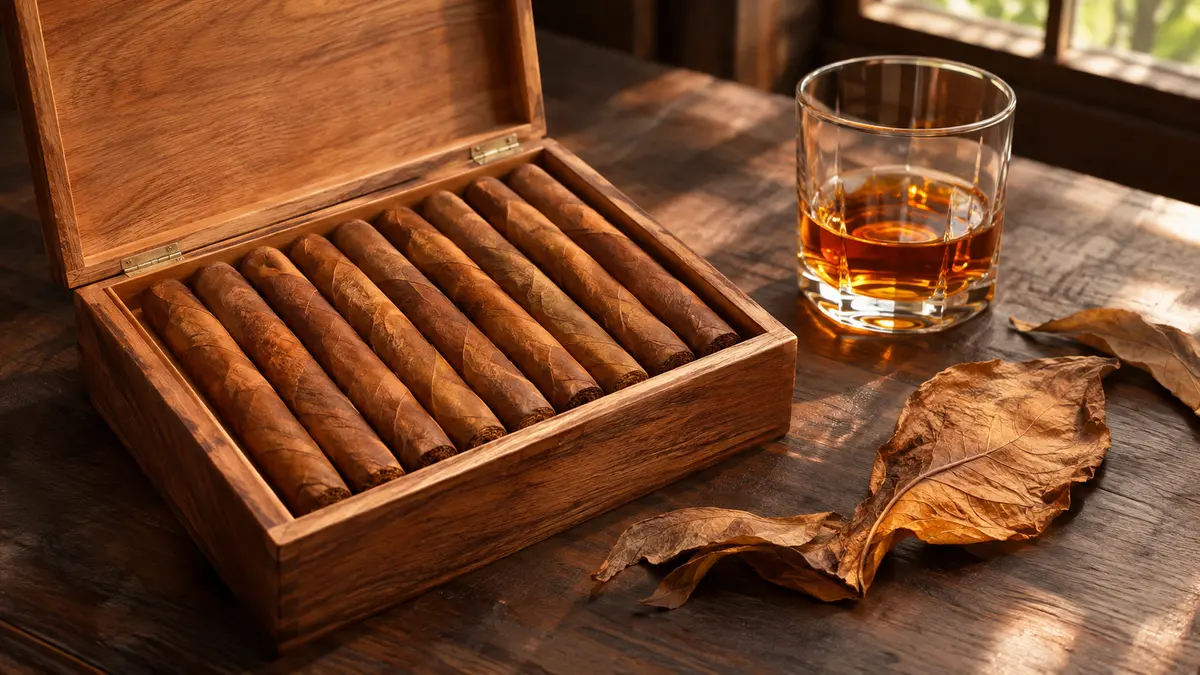
Cohiba Ambar
The Cohiba Ambar is a Cuban cigar made by Habanos S.A. as part of the Cohiba Linea Clasica. It was announced in 2021, reached shops about three years later, and in 2025 Cigar Aficionado placed it second on its Top 25 list. It shares its name, but nothing else, with the Cohiba sold in the United States.
Note on scope: every statement below refers to the Cuban Cohiba Ambar unless it says otherwise. No source found for this article describes a US-market product called Ambar.
Quick facts
| Item | What sources report |
|---|---|
| Maker | Habanos S.A. (Cuba) |
| Line | Cohiba Linea Clasica |
| Factory | El Laguito, Havana |
| Vitola (factory name) | Placeres |
| Size | 5 1/4 in (132 mm) by 53 ring gauge |
| Strength | Medium to full (Cigar Aficionado: medium-full) |
| Head | Pigtail cap |
| Packaging | Boxes of 10; later, three-packs in tubos |
| Announced | 2021, at the first Habanos World Days |
| Cigar Aficionado | 97 points, number 2 in the 2025 Top 25 |
Is the Cohiba Ambar a Cuban cigar?
Yes. The Ambar is a Habanos S.A. release, and Cigar Aficionado lists the filler, binder and wrapper as all Cuban. It is rolled at El Laguito, the Havana house that has been tied to Cohiba since the brand began.
This matters because "Cohiba" is also the name of a separate, non-Cuban cigar made for the US market. The two products share a name and little else: different makers, different tobacco, different factories. The Ambar belongs only to the Cuban line.
What is the Cohiba Ambar's size and vitola?
Most sources give 5 1/4 inches by 53 ring gauge, which is 132 mm. Cuban Cigar Online and Cigar Aficionado's tubo coverage both use the factory name Placeres for this format, which the Aficionado article describes as a short, fat Cuban shape.
When was the Cohiba Ambar released?
Habanos S.A. announced the Ambar in 2021 at the first Habanos World Days in 2021. Cigar Aficionado's tubo article says it was one of three Cohiba releases tied to the brand's 55th anniversary, and that smokers did not see it on shelves until about three years later. The magazine's Top 25 entry lists a 2024 release and a box date of March 2025.
Later, the cigar also appeared in tubos, the yellow-and-black pop-top tubes used for other Cohiba sizes. According to the same article, tubo availability was uneven: some countries had received them while others had not.
What makes the Ambar different from other Cohibas?
Two details come up repeatedly.
- Barrel fermentation. Cohiba is known for an extra fermentation of some of its leaf in wooden barrels. Cigar Aficionado reports that some of the Ambar's filler gets this additional step, and Cuban Cigar Online says the cigar uses only leaf that received it. The sources differ on whether some or all of the filler is barrel-fermented.
- The pigtail. The Ambar has a twisted pigtail cap. Cigar Aficionado links this to the Lancero, which it calls the first cigar to carry the Cohiba name, and notes that Behike, Lancero and Talisman sizes have similar heads.
Cigar Aficionado also says the tobacco comes from five top Cuban farms, which it describes as "the selection of the selection." That phrase is the magazine's description of the blend, not an independently audited claim.
What does the Cohiba Ambar taste like?
Reviewers do not fully agree, which is normal for a cigar judged by individual palates.
- Cigar Aficionado reports a core of oak and caramel, almond, and an elegant fruit finish, and praised its body, balance and resonance (97 points).
- Cuban Cigar Online lists cedar, leather, coffee, chocolate and spice, with a creamy, nutty opening and a finish of leather, coffee and cocoa.
- The site Cigarslover called it rather underwhelming, with hay and nut flavors after lighting.
Strength is described as medium to full. None of the sources describe it as the strongest Cohiba, and the line as a whole is usually positioned around balance and refinement rather than power.
How is the Cuban Cohiba different from the US Cohiba?
The Cuban Cohiba traces back to the mid-1960s. According to Wikipedia's account, cigars made by a Havana craftsman for Fidel Castro's circle led to an unbranded blend for officials, a private brand established in 1966 (Wikipedia also gives 1968 for its formal launch), and public sale from 1982. Cohiba was first made at El Laguito, a mansion converted into a rolling school in 1961.
The cigar sold in the United States under the same name is a different product, referred to here as non-Cuban Cohiba. It is sold by Scandinavian Tobacco Group (STG), is made in the Dominican Republic according to Wikipedia, and contains no Cuban tobacco. Effective February 2, 2026, STG moved non-Cuban Cohiba (with Punch and Havana Honeys) from its General Cigar sales division to its Forged Cigar Co. division, according to Tobacco Reporter.
The ownership of the name in the US is the subject of a long legal dispute, and coverage describes it as ongoing. On May 7, 2025, the US District Court for the Eastern District of Virginia upheld the Trademark Trial and Appeal Board's decision to cancel General Cigar's federal registrations of the COHIBA mark. Cigar Dojo reported that the ruling did not affect General Cigar's common-law rights and that STG was considering an appeal to the Fourth Circuit, during which STG said the registrations would remain valid. In October 2025 General Cigar filed a brief asking the Fourth Circuit to reverse the ruling, according to Tobacco Insider. This article does not take a position on who holds rights, and readers who need the current legal status should check court records.
Can you buy a Cohiba Ambar in the United States?
Rules on Cuban tobacco vary by country, and a cigar sold in one market may be unavailable or restricted in another. Check the laws that apply where you live and where you travel instead of relying on a general article. The Cohiba sold in US stores is the non-Cuban product described above, and this article does not describe any US-market Ambar.