

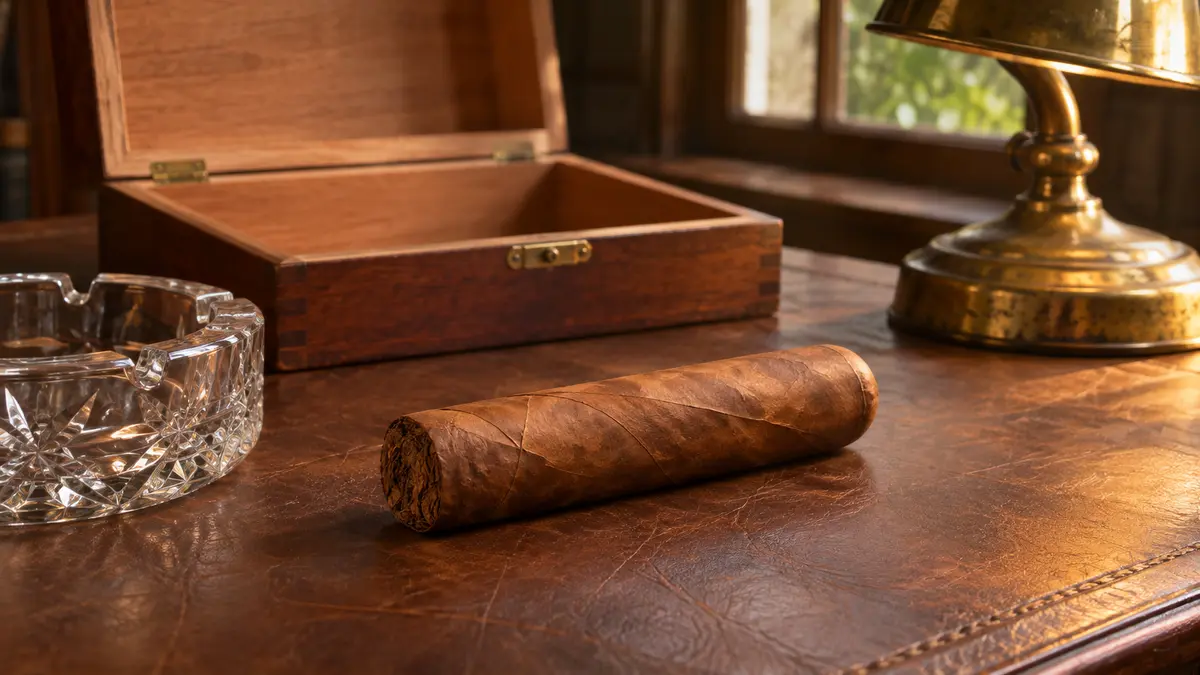
Partagás Serie D No. 4
The Partagás Serie D No. 4 is a hand-made Cuban robusto from the Partagás brand, distributed by Habanos S.A. It measures 4 7/8 inches (124 mm) with a 50 ring gauge, and it is one of the most widely recognised robustos in the Cuban catalogue. This article summarises what published sources say about its dimensions, history, packaging, flavour as described by reviewers, and the checks commonly recommended for spotting counterfeits.
Quick facts
| Item | Detail |
|---|---|
| Brand | Partagás (founded in Havana in 1845, per Wikipedia) |
| Name | Serie D No. 4 |
| Vitola de galera | Robusto |
| Length | 4 7/8 in (124 mm) |
| Ring gauge | 50 (19.84 mm) |
| Origin | Cuba; filler, binder and wrapper (Cigar Aficionado listing) |
| Producer / distributor | Habanos S.A. |
| Strength | Rated medium to medium-full by Cigar Aficionado, depending on the review |
| Common formats | Box of 25, box of 10 (since 2007), pack of three tubos (since 2009), per Quill & Pad |
| Selected Cigar Aficionado scores | 93 (January 2022 issue, No. 4 of its Top 25 of 2021), 94 (February 2023 issue), 90 (June 2026 issue) |
What is the Partagás Serie D No. 4?
It is a robusto: a short, thick cigar, rolled by hand with Cuban tobacco. Wikipedia lists it among the Partagás hand-made vitolas as Serie D No. 4, 4 7/8 in by 50, and gives the metric size as 124 x 19.84 mm. Cigar Aficionado describes it as one of the world's most popular Cuban cigars and notes its red band. Wikipedia goes further and says it is "widely regarded as the most sold Cuban cigar globally"; that is a statement about reputation rather than audited sales figures.
The name follows the Partagás alphabet-and-number scheme: a letter for the series and a number for the size within it.
What was the Alphabet Series, and when did the Serie D No. 4 appear?
According to a 2019 article on Quill & Pad, Partagás introduced a range in the 1930s that was aimed at the British market. It had four series, A, B, C and D, each numbered 1 to 4. The same article says the D4 was discontinued by the 1960s and that "the decision was made in 1975 to reintroduce the D4." Wikipedia also gives 1975 as the year for the Serie D No. 4.
Sources are not fully consistent about later history. Cigar Aficionado's 2022 tasting note traces the cigar to the 1930s Alphabet Series and says that "in 2005, Habanos revisited the series, eventually adding four sizes." Quill & Pad, however, ties 2005 to a different event: the Serie D No. 4 Reserva Cosecha 2000, made with tobacco harvested in 2000, aged three years, and released in 2005 as part of the Reserve Series, with 5,000 black lacquered boxes of 20. Cigar Aficionado's rating page for that Reserva says it debuted at the annual Havana cigar festival, came in numbered black lacquered boxes, carries a second black-and-silver band, and scored 92 points (Top 25 of 2005, rank 5). Both Quill & Pad and Wikipedia place the standard D4 on the market from 1975, so the 2005 date refers to Habanos returning to the series, with the Reserva and new sizes, rather than to the first appearance of the regular cigar.
Other Serie D sizes followed as limited editions. Wikipedia dates Serie D No. 3 to 2001 (re-released 2006), No. 2 to 2003, No. 1 to 2004 and No. 5 to 2008. Quill & Pad adds that Nos. 5 and 6 have since become standard production lines.
What are the size, blend and packaging?
The size is 4 7/8 in by 50 ring gauge. Cigar Aficionado's listing confirms Cuban filler, binder and wrapper but, like the other sources checked, does not publish a leaf-by-leaf blend breakdown, so none is given here. The factory name is also not stated for this vitola in the sources consulted; Wikipedia notes only that the historic Partagás factory in Havana moved to a new building on 2 January 2012.
Quill & Pad describes boxes of 25 as the most familiar format, with boxes of ten available since 2007 and packs of three tubed cigars since 2009. Cigar Aficionado has also reviewed a tubo version separately.
Wikipedia gives this cigar the factory name Robusto. The label "robusto extra" belongs to larger Partagás sizes such as Serie D No. 2.
How do reviewers describe the flavour?
Descriptions vary by vintage and reviewer, which is normal for hand-made cigars.
- Cigar Aficionado, January 2022 (93 points, medium): leather, minerals and wood from the first puff, with sweeter orange and vanilla notes and a lingering hazelnut finish.
- Cigar Aficionado, February 2023 (94 points, medium-full): a spicy, tangy start with a burst of horseradish, becoming a warmer, nuttier smoke with bold accents of leather and wood before a baked-apple finish.
- Quill & Pad (2019): spicy, earthy, with leather and cedar or wood notes, toward the fuller-bodied end; the author praises its balance and says it is approachable young and ages well. The author also cites Min Ron Nee's 2004 book, which describes earthy, peppery notes.
The common threads are leather, wood and earth, with pepper early on. Strength ratings run from medium to medium-full, so personal impressions will differ.
How can you spot a fake Partagás Serie D No. 4?
Counterfeiting affects popular Cuban brands, and a widely sold cigar like the D4 is an obvious target. The points below come from Cigar Aficionado's article on counterfeit Cuban cigars (December 2019).
- Genuine labels and seals are applied to the box. Fakes often come with loose stickers inside for the buyer to apply.
- Every box carries a barcode on the edge of the Cuban warranty seal. Cigar Aficionado says it can be checked on Habanos.com, and that if the description does not match what is in the box, the box is not genuine.
- Habanos does not make clear-lid or glass-top boxes, so those are counterfeit.
- Cigars with intertwined multicoloured wrappers ("barber pole") do not occur among real Cuban cigars.
- Offers from people claiming a factory connection, at a steep discount, should be avoided; Cigar Aficionado says you are likely buying a fake.
Some of the checks in that article are written about Cohiba specifically (for example the Behike box rules) and do not apply to the D4. None of these checks is conclusive alone, and a real box can in principle hold other cigars. Buying from established, licensed retailers reduces the risk.
How does it compare with similar robustos?
Several Cuban brands list a robusto of identical dimensions. Wikipedia gives Hoyo de Monterrey Epicure No. 2 as 124 mm by a 50 ring gauge (19.84 mm), with the factory name Robustos, and Ramón Allones Specially Selected as 4 7/8 in by 50 (124 x 19.84 mm), also a Robusto. In practice that means the three cigars are the same shape and size, and differences come down to each brand's blend and house character rather than dimensions. The sources used here do not support a direct flavour ranking between them, so this article does not attempt one. Cigar Aficionado reviews of each cigar are a useful place to compare tasting notes issue by issue.
Laws and rules about buying or importing Cuban cigars differ depending on where you live, so check your country's and local laws.