
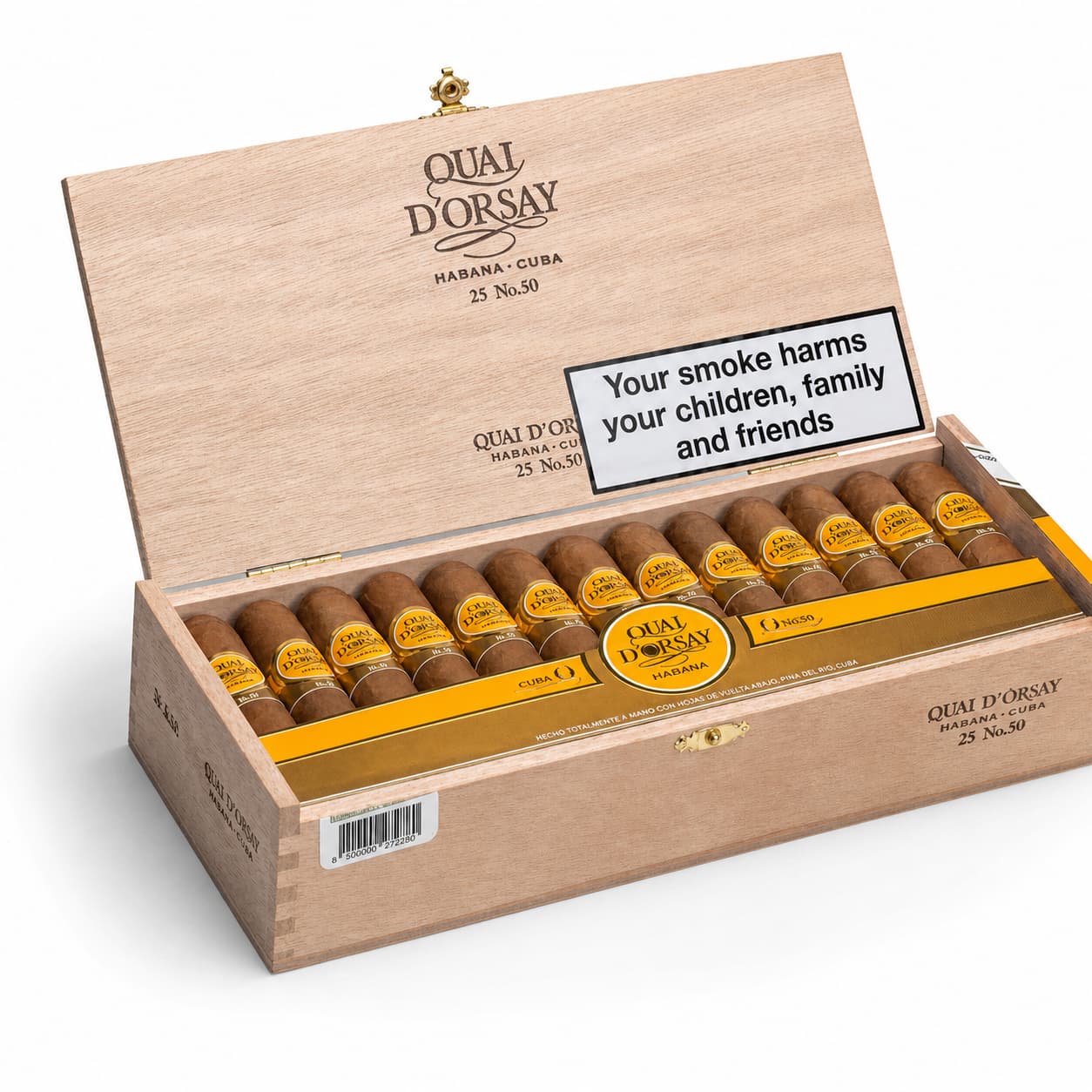

Quai D’Orsay No.50
Quai D'Orsay No.50 Cigar






At a glance
Quai D’Orsay No.50
There's a particular quality of light that falls on the Left Bank of Paris in late afternoon — golden, diffused, unhurried. It's this same sensibility that the Quai D'Orsay brand has carried since its 1970s origins, conceived originally for the French market with a profile that favors elegance over power, nuance over brute force. The No.50, introduced in December 2017 as part of the brand's comprehensive revitalization, distills this Franco-Cuban philosophy into a compact format that asks nothing more than an hour of your attention and rewards it generously.
Specifications
| Attribute | Details |
|---|---|
| Vitola | D No. 5 (Petit Robusto) |
| Ring Gauge | 50 |
| Length | 110mm (4 3/8") |
| Factory | Cuban (Habanos) |
| Strength | Mild-Medium |
| Wrapper | Cuban |
| Binder | Cuban |
| Filler | Cuban |
| Box Count | Box of 25, Box of 10, Single |
The Story
The Quai D'Orsay name itself evokes place — the Quai d'Orsay being the Parisian embankment along the Seine that houses France's Ministry of Foreign Affairs. When the brand was created, it was with the explicit intention of suiting the French palate: lighter, more refined, less aggressive than the full-bodied offerings that dominated Cuban portfolios. For decades, it remained something of a quiet secret, appreciated by those in the know but never achieving the commercial dominance of a Cohiba or Montecristo.
The 2017 relaunch changed everything. Habanos invested significantly in reimagining the brand's visual identity and blend architecture. The No.50 emerged as one of the stars of this renaissance — a Petit Robusto format that perfectly captures the modern smoker's desire for quality without time commitment. The cigar wears a special band distinct from the rest of the line, signaling its unique position. What makes the No.50 particularly compelling is how it demonstrates that delicacy need not mean simplicity. This is a cigar that speaks in complete sentences rather than shouting in exclamation points.
The Tasting Experience
First Light
The opening act greets you with an immediate brightness — lemon zest and orange peel dancing above a foundation of dry cedar. There's a distinctive saline quality here, a whisper of sea air that lends sophistication rather than distraction. The draw offers minimal resistance, and the burn establishes itself with the kind of uniformity that suggests skilled hands at the rolling table. Notes of fresh hay and a subtle ginger warmth begin to emerge as the cigar settles into its rhythm. This is not a cigar that demands your attention through force; it invites it through intrigue.
The Journey
As you transition into the second third, the citrus notes recede to make room for richer terrain. Hazelnut emerges as a defining characteristic — toasted, slightly sweet, reminiscent of pralines in a Parisian confectioner's window. Vanilla bean weaves through the profile now, accompanied by a cinnamon dusting that adds warmth without heat. The cedar foundation remains, but it's joined by brioche-like qualities: buttery, yeasted, comforting. A floral undertone begins to develop, lending an airy quality that keeps the experience from becoming heavy. The balance here is exemplary — each flavor has its moment without overwhelming its neighbors.
The Finale
The final act brings a gentle intensification. The hazelnut and vanilla notes deepen, taking on characteristics of toffee and brown butter. A faint mineral quality emerges — graphite and wet stone — that speaks to the cigar's Cuban terroir. The citrus returns in a more subdued form, now suggesting lemon sorbet rather than fresh zest, a cooling counterpoint to the warming flavors. There's a touch of bittersweet chocolate in the final draws, though it never dominates. The finish is clean and moderately long, leaving echoes of cedar and toasted nuts on the palate. At no point does the cigar become harsh or bitter in the unpleasant sense; it maintains its composure throughout.
Who It's For
The No.50 is ideal for the smoker who appreciates subtlety over strength — the kind of aficionado who can detect the difference between vanilla bean and vanilla extract, who understands that power is not the only measure of quality. It suits the morning smoke with espresso as readily as it does an afternoon interlude. This is also a magnificent entry point for those new to Cuban cigars, offering approachability without sacrificing authenticity. For the experienced palate, it serves as a reminder that Cuba can produce cigars of genuine delicacy.
Pairing Suggestion
A well-made cappuccino or café crème provides the ideal companion — the milk's sweetness amplifies the hazelnut and vanilla notes while the espresso's bitterness creates a counterpoint to the cigar's inherent gentleness. For something stronger, a VSOP Cognac mirrors the cigar's French heritage and complements its refined character.
 Traceable to factory and harvest year · Duty Free Authentic Cuban
Our Promise
Every cigar guaranteed authentic Habanos — traceable to factory and harvest, humidified, shipped duty free.
Our guarantee →
Perfect pairings

Related Articles
Quai d'Orsay
Quai d'Orsay: A Half Century of French-Cuban Heritage Quai d'Orsay stands as one of the most distinctive brands in the Habanos portfolio, born from a...
Cigar InfoQuai d'Orsay Acuerdo Edición Regional Rusia
Quai d'Orsay Acuerdo Edición Regional Rusia Regional Edition Series The Quai d'Orsay Acuerdo represents a distinguished addition to Habanos' Regional...
Cigar InfoQuai d'Orsay Ambassadeur Edición Regional Andorra
Quai d'Orsay Ambassadeur Edición Regional Andorra The Quai d'Orsay Ambassadeur stands as a distinguished addition to the Regional Edition series,...