
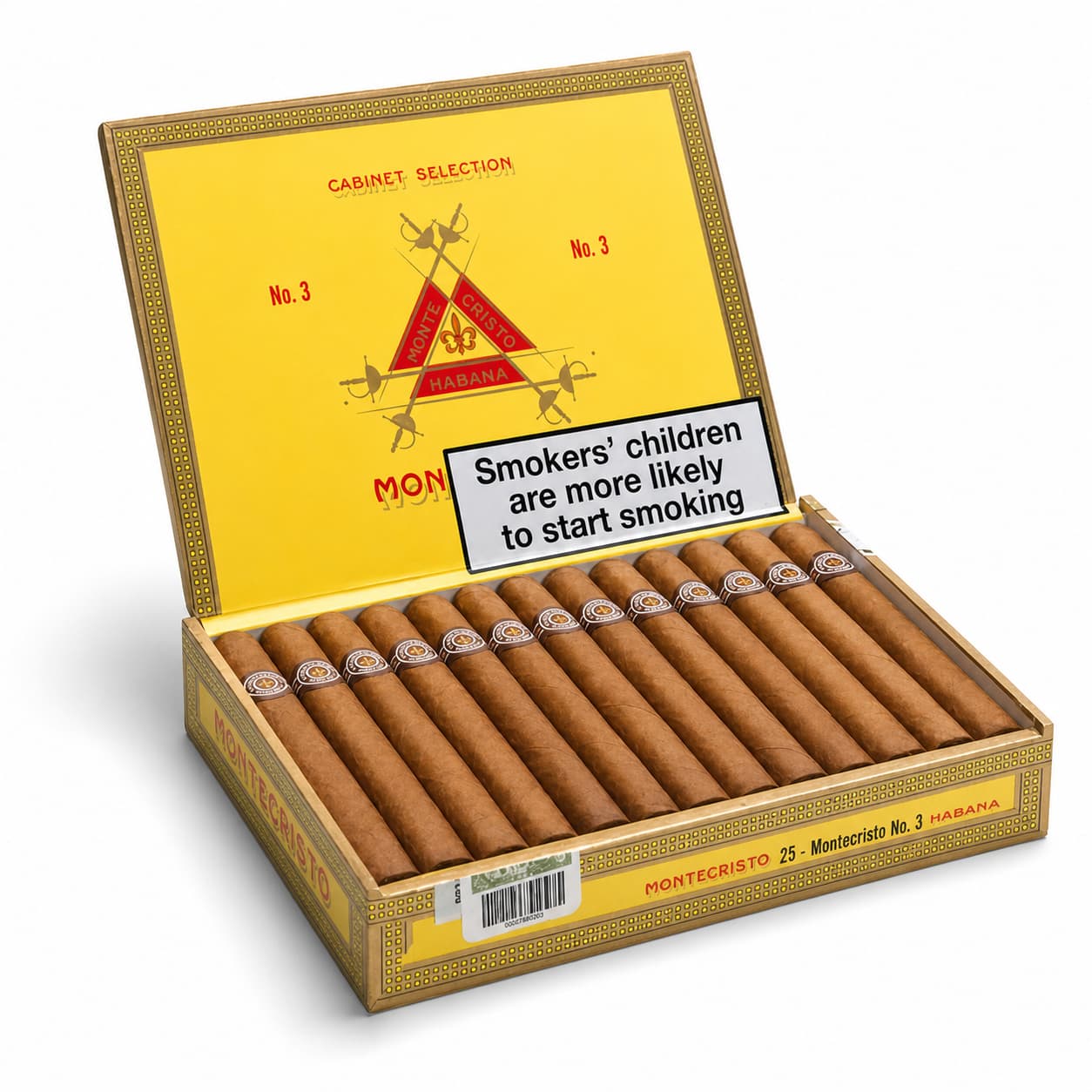

Montecristo No.3





At a glance
Montecristo No.3
There are dimensions in the cigar world that simply feel correct in the hand—the proportions so natural, so time-tested, that they become the definition of what a cigar ought to be. The Corona format, measuring 142mm with a 42 ring gauge, represents precisely this: the measuring stick against which all other vitolas are judged. And when that classic silhouette wears the most recognized band in Cuban tobacco, you have something that approaches a smoking archetype. The Montecristo No.3 has been teaching smokers what Cuban tobacco tastes like since 1935, and it has lost none of its instructional power.
| Specification | Details |
|---|---|
| Vitola | Corona (Factory Name: Coronas) |
| Ring Gauge | 42 |
| Length | 142mm (5 5/8") |
| Factory | Habanos S.A., Pinar del Río/Vuelta Abajo |
| Strength | Medium to Medium-Full |
| Wrapper | Vuelta Abajo Selected Leaves |
| Box Count | Box of 25, Pack of 5, Single |
When Montecristo emerged from the H. Upmann factory in 1935, the brand's founders chose to name their creation after Alexandre Dumas's serialized adventure novel, *The Count of Monte Cristo*—a story that captivated cigar rollers as it was read aloud on the galerones of Havana's factories. The numbered series became the brand's foundation, and the No.3 established itself as the Corona benchmark: substantial enough to deliver the full Montecristo experience, yet compact enough for an hour's contemplation. Nearly nine decades later, this vitola remains in continuous production, a testament to proportions that needed no improvement. The No.3 offers something its larger siblings cannot—a concentrated expression of the house blend that never overstays its welcome, making it perhaps the most honest cigar in the regular production lineup.
The tasting experience opens with an immediate declaration of Montecristo's signature character. First light brings toasted cedar and dry cocoa powder in equal measure, the kind of opening that feels familiar before you've drawn twice. There's a creaminess to the smoke texture that tempers what could otherwise be an aggressive start—a vanilla-bean sweetness that wraps around the palate rather than assaulting it. Black pepper surfaces on the retrohale, present but never dominant, providing structure rather than heat. The combustion is flawless from the first inch, a sign of the leaf selection and fermentation standards that separate Cuban production from imitators.
The journey through the second third deepens rather than transforms. This is not a cigar that relies on dramatic evolution to maintain interest; instead, it builds intensity within its established framework. The coffee notes shift from espresso bitterness toward something closer to café con leche—still roasted and substantial, but now carrying that characteristic Cuban creaminess. The cedar remains constant, a backbone against which other flavors arrange themselves. Cocoa evolves from dry powder toward a darker, more bitter chocolate character, and a subtle honeyed quality emerges on the lips, the kind of sweetness that comes from expertly fermented wrapper leaf rather than added influence. The draw remains perfect, the ash holding firm in that distinctive slate-grey column that marks well-aged Cuban tobacco.
The finale brings the pepper forward without overwhelming the blend's fundamental balance. The medium-full strength asserts itself more directly now, the nicotine content making its presence known in the shoulders and temples—a gentle reminder that this compact format still carries genuine tobacco authority. The coffee and cedar partnership persists to the final centimeter, joined by a leathery earthiness that grounds the sweeter elements. There's no harshness, no heat, just a gradual intensification of everything that came before. The finish lingers with roasted nuttiness and a whisper of citrus zest, the so-called "Cuban twang" that devotees recognize as the signature of genuine Vuelta Abajo leaf.
This is the cigar for the smoker who values proportion over presence, who understands that a Corona offers something a Toro cannot—intensity without extension, concentration without excess. It suits the midday break, the post-lunch moment when you have an hour but not two, when you want the complete Cuban experience without committing to a larger format. The No.3 is also the ideal teaching cigar: put one in the hand of someone learning what Cuban tobacco should taste like, and they will understand the benchmark within thirty minutes.
Pair this with a Cuban-style espresso or a aged dark rum served neat—the coffee will amplify the cocoa and cedar notes, while the rum's sweetness will find harmony with the honeyed undertones that develop through the second third.
 Traceable to factory and harvest year · Duty Free Authentic Cuban
Our Promise
Every cigar guaranteed authentic Habanos — traceable to factory and harvest, humidified, shipped duty free.
Our guarantee →
Perfect pairings

You may also like
Related Articles
Montecristo
Montecristo Cigar Bands: A Visual History The iconic Montecristo brand has undergone several distinctive band designs throughout its storied history....
Cigar InfoMontecristo 80 Aniversario 80 Aniversario
Montecristo 80 Aniversario The Montecristo 80 Aniversario stands as a distinguished commemorative release from one of Cuba's most celebrated cigar...
Cigar InfoMontecristo Almirantes Réplica de Humidor Antiguo
Montecristo Almirantes Réplica de Humidor Antiguo A Prestigious Addition to the Replica Antique Humidor Series The Montecristo Almirantes stands as a...