
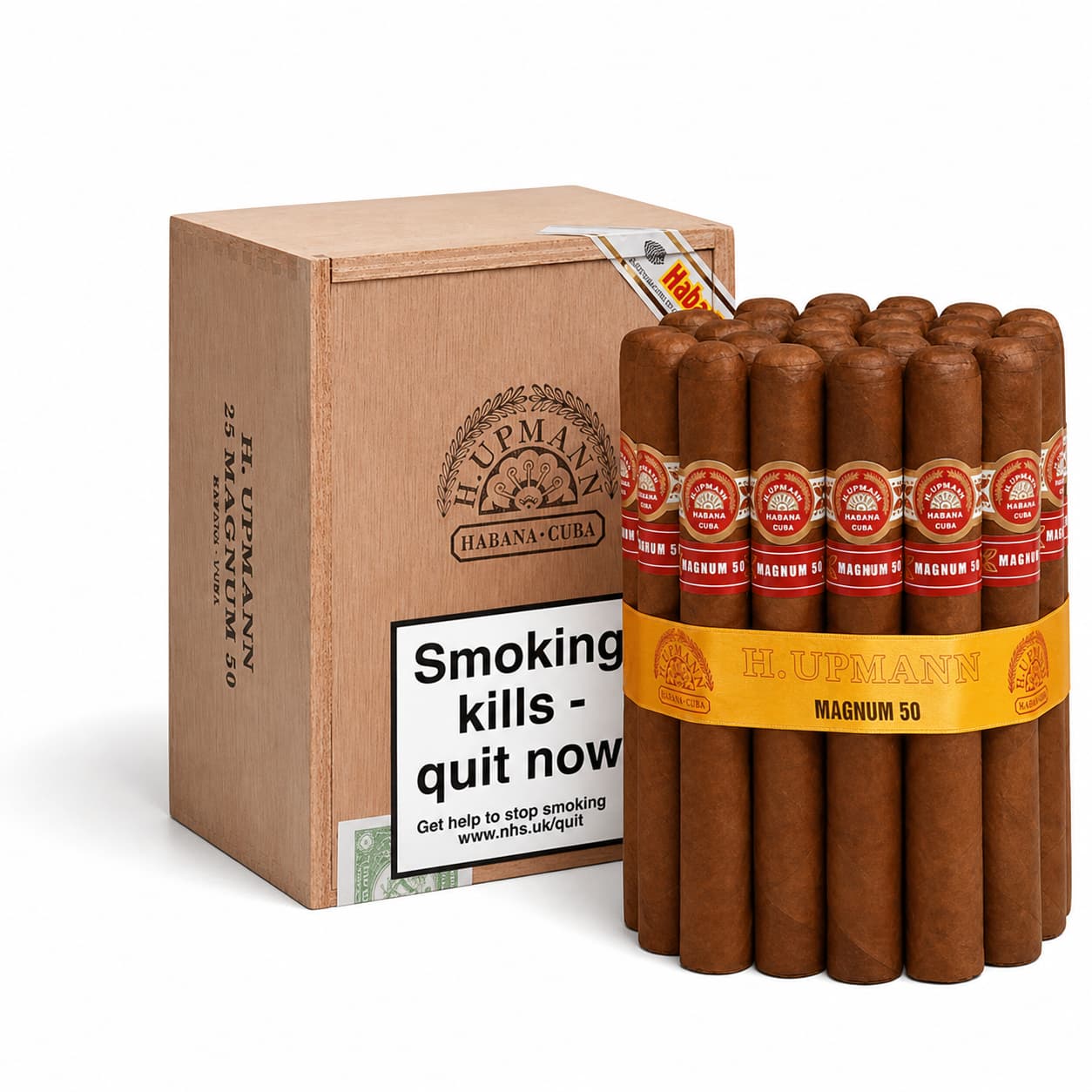

H. Upmann Magnum 50






At a glance
H. Upmann Magnum 50
There is a particular kind of conversation that unfolds when a cigar earns its place in a humidor through quiet merit rather than loud proclamation. The H. Upmann Magnum 50 is precisely such a cigar—one that arrived in 2008 as a permanent addition to the brand's roster, yet carries the DNA of something far more exclusive: a 2005 Edición Limitada that smokers refused to let fade into memory.
| Specification | Details |
|---|---|
| Vitola | Magnum 50 (Double Robusto) |
| Ring Gauge | 50 |
| Length | 160mm (6 1/4") |
| Factory | Habanos de Cuba |
| Strength | Medium |
| Wrapper | Cuban (Colorado) |
| Box Count | Box of 25, Box of 10, Pack of 3 Tubos, Single, Single Tubos |
The Story Behind the Smoke
H. Upmann has never been a brand that chases attention. Founded in 1844 by a German banker with a fondness for Havana, the house built its reputation on restraint—cigars that delivered complexity without demanding the smoker's complete surrender. The Magnum 50 embodies this philosophy in a format that feels almost anachronistic in the modern era: substantial enough to command 90 minutes of contemplation, yet never overwhelming.
The vitola's origin story adds a layer of intrigue to every box. When H. Upmann released the Magnum 50 as a Limited Edition in 2005, the response was immediate and sustained. Smokers wrote letters. Retailers petitioned Havana. The message was clear: this was too good to remain a fleeting encounter. By 2008, the Magnum 50 had earned standard production status—a rare promotion that speaks to something exceptional in the blend. The cigar uses Vuelta Abajo tobacco throughout, with a wrapper aged two years before rolling, a detail that reveals itself in the smoke's polished character.
What makes the Magnum 50 culturally significant is its position as a bridge cigar—accessible enough for the ascending enthusiast, sophisticated enough for the seasoned palate. It represents H. Upmann's modern identity while honoring the bank-house formality of its origins.
The Tasting Experience
First Light: The Opening Statement
The initial draws bring a composed greeting: dry graham cracker and toasted almond, with a faint saltiness that calls to mind a well-aged Manchego. There is earth here, but it is the earth of a tended garden rather than raw soil—cultivated, refined. The wrapper's Colorado hue hints at the mild-medium strength to come, and the combustion is flawless from the first inch, producing a dense ash that holds with architectural precision. A whisper of berry sweetness drifts in and out, playing against the dominant grain-and-nut character like a half-remembered melody.
The Journey: The Middle Movement
As the burn passes the first third, the Magnum 50 reveals its surprising depth. Caramel emerges as the dominant note—not the cloying sweetness of confection, but the restrained caramelization of properly executed crème brûlée. Fruit notes develop with unexpected sophistication: dried apricot and white peach, layered over a vanilla-and-cinnamon base that brings to mind a well-stocked pantry in an old Havana house. The strength remains in the medium register, but the complexity has widened considerably. This is where the cigar distinguishes itself from lesser robustos; the flavor trajectory is not linear but orchestral, with themes introduced, developed, and revisited.
The Finale: The Closing Argument
The final third brings a dignified shift. Oak and birch woodiness rise to meet the lingering caramel, while a measured black pepper spice appears on the retrohale. There is a citrus brightness now—something approaching lemon zest—that cuts through the richer elements without disrupting them. A subtle leather note joins the composition, recalling the brand's banker-heritage: well-worn briefcases and private offices. The smoke remains cool and voluminous to the final centimeter, a testament to the construction standards that earned this blend its permanent place in the H. Upmann lineup.
Who It's For
The Magnum 50 is the cigar for the smoker who values evolution over impact—someone who appreciates that the best conversations unfold gradually, with digressions and returns. It suits the post-prandial moment when dinner has concluded but the evening should not: a Thursday night reward, a Saturday afternoon on the terrace, or the quiet hour between a day's work and its reckoning. This is not a cigar for the nicotine-chaser, but for the flavor-chaser—the smoker who reaches for a cigar to discover something, not merely to consume it.
Pairing Suggestion
A aged rum from eastern Cuba—particularly a Santiago de Cuba 11 or 15 year—will mirror the caramel and oak notes while adding its own dried-fruit dimension. For those who prefer non-spirits, a properly prepared café con leche draws out the graham cracker and nutty characteristics beautifully.
 Traceable to factory and harvest year · Duty Free Authentic Cuban
Our Promise
Every cigar guaranteed authentic Habanos — traceable to factory and harvest, humidified, shipped duty free.
Our guarantee →
Perfect pairings

Related Articles
H. Upmann
H. Upmann Band Reference Guide The visual identity of H. Upmann cigars has evolved considerably throughout the brand's storied history. Collectors...
Cigar InfoH. Upmann 160 Aniversario Humidor
H. Upmann 160 Aniversario Humidor The H. Upmann 160 Aniversario Humidor stands as one of the most significant commemorative releases in Cuban cigar...
Cigar InfoH. Upmann Amatistas
H. Upmann Amatistas The H. Upmann Amatistas stands as a notable entry in the brand's extensive catalog, representing a vitola that enjoyed decades of...