
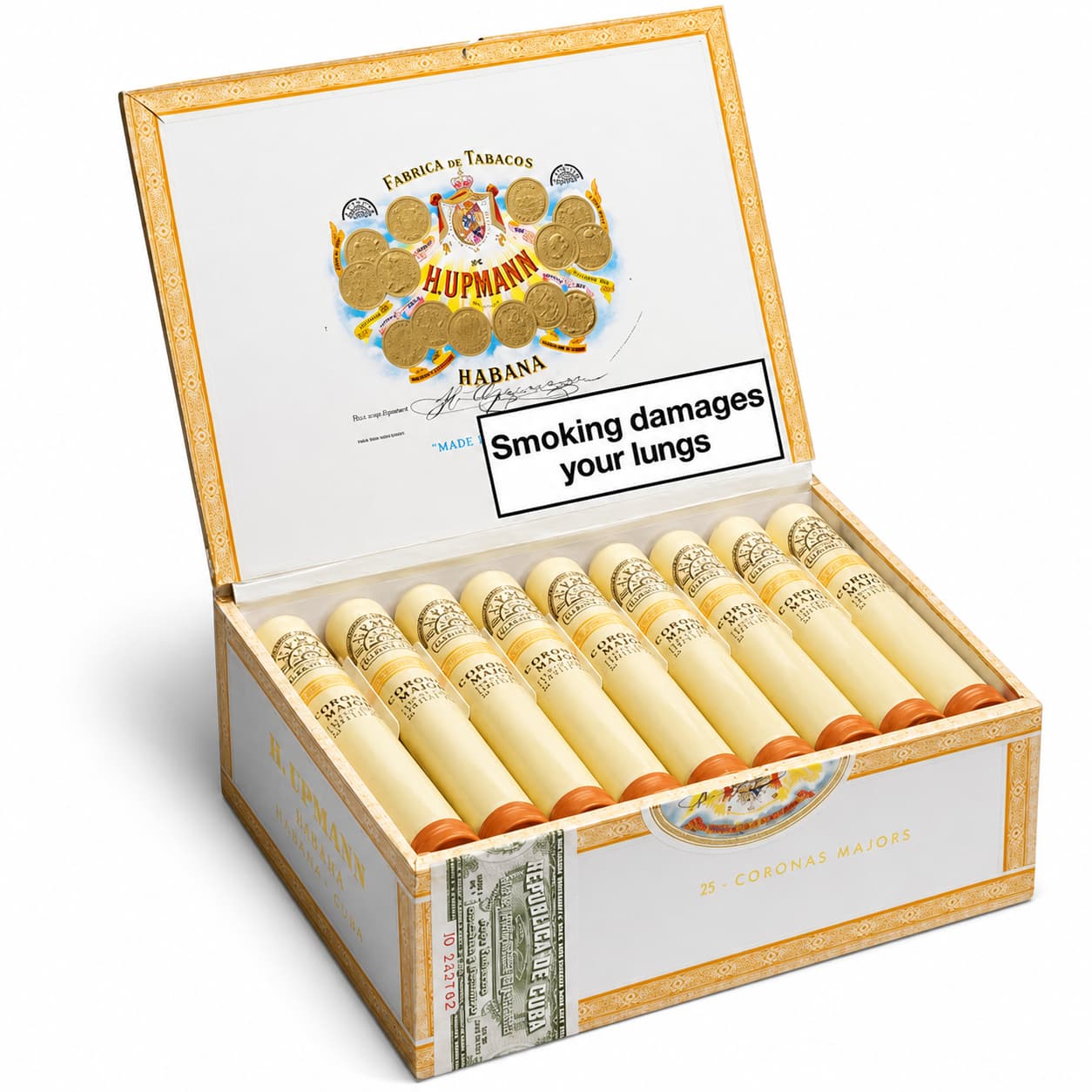

H. Upmann Coronas Majors Tubos






At a glance
H. Upmann Coronas Majors Tubos
There is a particular satisfaction in reaching for a cigar that asks nothing of you but your attention. No bravado, no overwhelming potency, no need to brace yourself against an assault of strength. Just a quiet invitation to settle in and let the minutes dissolve into something worth remembering.
| Specification | Details |
|---|---|
| Vitola | Eminentes |
| Ring Gauge | 42 |
| Length | 132mm (5.2") |
| Factory | Cuba |
| Strength | Light-Medium to Medium |
| Wrapper | Cuban |
| Box Count | Box of 25 |
The H. Upmann brand carries the distinction of being one of the oldest Cuban cigar marques still in production, founded in 1844 when German banker Hermann Dietrich Upmann opened a Havana factory alongside his banking interests. That dual heritage—a banker's precision married to a blender's art—explains much about the character of cigars bearing this band. The Coronas Major, housed in its protective aluminum tube, embodies the restrained elegance that has defined H. Upmann for nearly two centuries. This is not a cigar that announces itself; it is one that reveals itself, layer by measured layer, to those patient enough to listen.
The Eminentes vitola—a 42 ring gauge by 132mm—represents a rationalization that occurred in 2002, when Habanos consolidated two separate cigars that had carried the Coronas Major name. The result is a corona-sized format that sits comfortably in the hand without demanding the commitment of a robusto or the endurance of a churchill. The aluminum tubes serve both practical and aesthetic purposes: protection for the delicate wrapper during transport and travel, and a presentation that speaks to the cigar's heritage as a gentleman's companion. An 89-point rating from Cigar Aficionado noted its "even draw and burn"—the kind of quiet competence that H. Upmann has built its reputation upon.
First Light
The cold draw offers a preview of what awaits: barnyard hay, dried leaf, and a whisper of chocolate that suggests sweetness without promising it. The initial flame brings cedar forward immediately—not the sharp, green cedar of youth, but the toasted, seasoned cedar of a cigar that has been allowed to settle into itself. Leather emerges along the edges, the kind you find in a well-worn briefcase or a favorite armchair, and there is coffee too, but it reads as espresso rather than the darker roast. The draw offers just enough resistance to slow you down, and the burn line establishes itself as even and deliberate from the first inch.
The Journey
The second third deepens the narrative. The cedar remains the central voice, but now it carries companions: toasted nuts begin to appear in the retrohale, and the leather takes on a sweeter character, almost like polished saddle leather rather than the drier expression of the opening. The strength remains firmly in the light-medium to medium territory, allowing the flavors to develop complexity without overwhelming the palate. There is a creaminess here that coats the mouth and invites contemplation rather than analysis. This is the section where the banker's precision becomes apparent—every element in its place, nothing overstated, nothing neglected.
The Finale
The final act brings a gentle intensification. The coffee notes that had been background players move toward the front, now accompanied by a woody bitterness that balances the sweeter elements. The nutty quality persists into the finish, and there is a subtle spice that emerges only in the last inch—not pepper, but something closer to toasted coriander or dried baking spices. The cigar never pushes past medium strength, even at its most assertive moment, and it finishes as it began: composed, dignified, and unwilling to overstay its welcome.
Who It's For
The Coronas Major is the cigar for the smoker who values consistency over theatrics, for the business traveler who needs a reliable companion for a hotel balcony after a long day of meetings, for the afternoon smoker who wants something substantial enough to satisfy but not so demanding that it derails the remainder of the day. It suits the moments when you want to think rather than be overwhelmed, when the cigar is meant to accompany rather than dominate. This is a cigar for those who understand that quiet excellence needs no announcement.
Pairing Suggestion
A aged añejo tequila or a mild, sweetened espresso complements the cigar's cedar and coffee notes without competing with its understated character.
 Traceable to factory and harvest year · Duty Free Authentic Cuban
Our Promise
Every cigar guaranteed authentic Habanos — traceable to factory and harvest, humidified, shipped duty free.
Our guarantee →
Perfect pairings

Related Articles
H. Upmann
H. Upmann Band Reference Guide The visual identity of H. Upmann cigars has evolved considerably throughout the brand's storied history. Collectors...
Cigar InfoH. Upmann 160 Aniversario Humidor
H. Upmann 160 Aniversario Humidor The H. Upmann 160 Aniversario Humidor stands as one of the most significant commemorative releases in Cuban cigar...
Cigar InfoH. Upmann Amatistas
H. Upmann Amatistas The H. Upmann Amatistas stands as a notable entry in the brand's extensive catalog, representing a vitola that enjoyed decades of...